Buddhist holy days (Thngai Sil)
By Khmer Calendar editorial · Last updated 2026-09-26
Original guide: what Thngai Sil holy days are, how the 8/15 waxing and waning observances work in Cambodia, and how to find them on this calendar.
Uposatha
Thngai Sil is the regular holy day that Cambodian Buddhists keep in step with the moon, a rhythm that stretches back to the lifetime of the Buddha. The purpose is simple and down to earth: pause the usual rush, settle a busy mind, and make room for a little calm and gladness. Monastics and lay supporters both lean into practice on these days, studying a little more, sitting a little longer, and renewing the friendship between pagoda and village. Most visitors take Five Precepts for the day, while those who want a stricter observance take eight, and everyone gives time to chanting, listening to teachings, and quiet meditation. On this calendar, look for day cells with a small temple mark — those are the Thngai Sil days.
Theravada countries
How many observance days fall in a month depends on local custom, with traditions keeping anywhere from two to six days in each lunar cycle.
Across Theravada countries the familiar pattern tracks the four turns of the moon, roughly once a week: new moon, full moon, and the two half-moons in between. Some communities give special weight to the new-moon and full-moon gatherings, the two times in the month when monks and nuns traditionally come together to recite their monastic rules. In Cambodia the dates you will see marked are the 8th and 15th of the growing and shrinking fortnights — 8 kout, 15 kout, 8 roch, and 15 roch — so open those cells for the temple sign and the lunar detail.
Lay practice
On each observance day, devoted lay men and women often take the Eight Precepts for twenty-four hours, a way of walking for a day in the footsteps of liberated disciples. The first five run close to the everyday five: avoid taking life, avoid taking what is not given, avoid harsh or false speech, and avoid drink and drugs that cloud the mind — except that the third becomes complete restraint from intimate relations rather than simply avoiding misconduct. The remaining three give the day its monastic flavour: take no solid food after midday, avoid shows, dancing, singing, music, garlands, perfumes, cosmetics, and jewellery, and avoid high or luxurious beds and seats. The set resembles the training kept by novices, made workable for household life by leaving out the rule about handling money.
If you live near a pagoda, the day is a natural time to drop in: bring an offering, join the morning chanting, listen to a short sermon, and sit with the group for meditation. If the nearest pagoda is far away, keep the spirit at home instead — sit one extra session or sit a little longer, read or chant a familiar passage, reflect quietly on the teachings, or set aside a small gift for someone in need.
At present this kind of day-long vow is most visible in Theravada South and Southeast Asia, though it was once kept widely elsewhere too and has never fully disappeared. For many households it works like a gentle doorway: one clear day of simple living shows what a monastic rhythm feels like, and sometimes it draws people a step closer to the pagoda.
Vesak
Vesak, known in Cambodia as Visak Bochea and in other places as Buddha Day or Buddha Purnima, is the brightest date in the Buddhist year for much of South and Southeast Asia, Tibet, and Mongolia. Theravada and many other schools use the full-moon day to honour three turning points together: the birth of Prince Siddhattha, his awakening as the Buddha, and his final passing. The name itself comes from the lunar month of Visakha, the month linked with his birth.
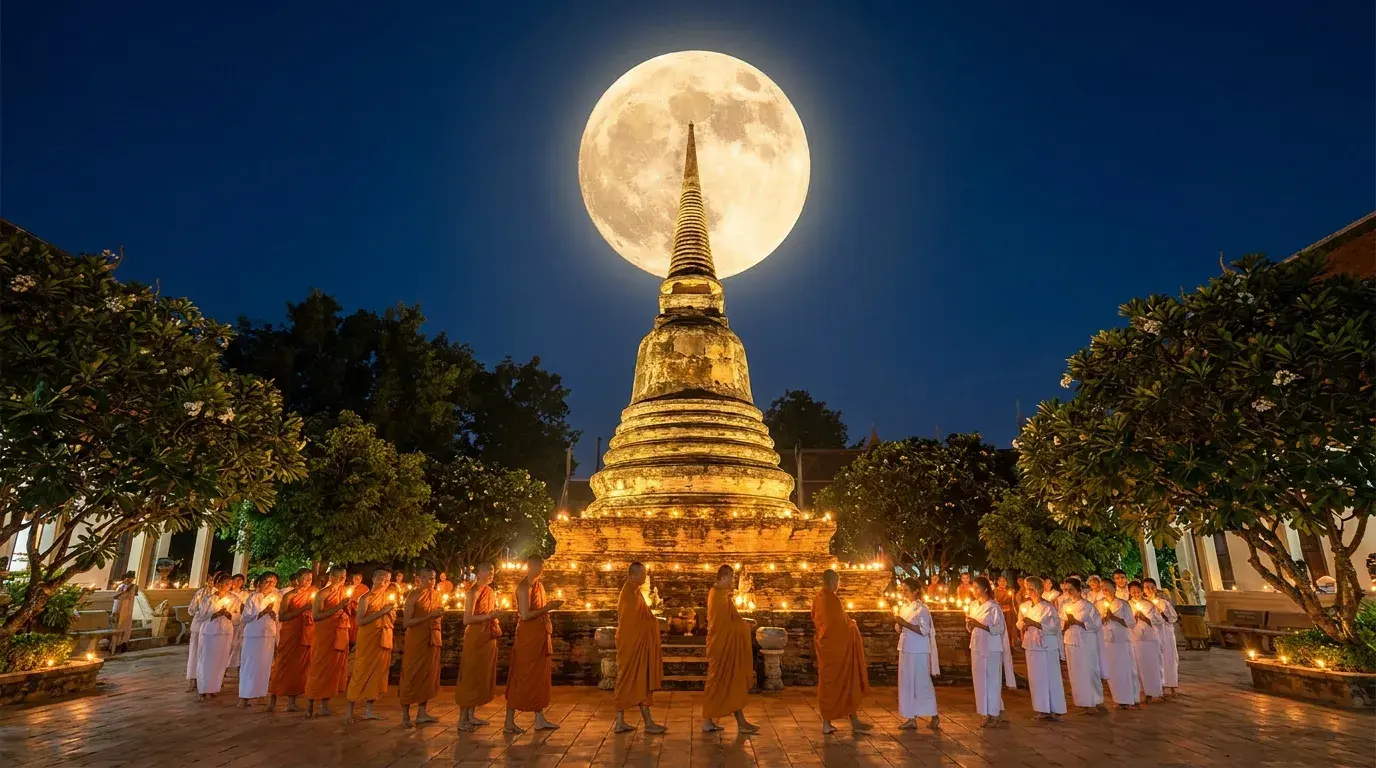
East Asia handles the calendar a little differently, often celebrating the birthday near the Vesak season while keeping the awakening and the passing on separate dates. In the southern tradition, though, one full-moon day in Visakha carries all three memories at once, which is why pagodas fill early, offerings feel especially weighty, and the evening often ends with candlelit walking around the shrine. Check the May pages on this site for the exact Gregorian date each year.
Dates of observance
The Gregorian date of Vesak moves because it follows Asian lunisolar reckoning, centred on the month of Vaisakha that gives the festival its name. In Nepal, the country of the Buddha's birth, the same full-moon day is widely kept as Buddha Purnima, with purnima simply meaning full-moon day. In Theravada calendars it lands on the full-moon observance day, usually in the fifth or sixth lunar month.
In Sri Lanka, Nepal, India, Bangladesh, and Malaysia the public celebration now clusters around the first full moon of May. Elsewhere the date slides with the moon from year to year, normally in April or May and occasionally in June after a leap month. Bhutan keeps the 15th day of the fourth lunar month, while Thailand, Laos, Singapore, and Indonesia keep the 14th or 15th day of the fourth month in the Chinese reckoning. China, Korea, Vietnam, and the Philippines honour the birthday on the 8th day of that fourth month, Japan keeps 8 April by the Gregorian calendar, and Myanmar marks the Full Moon of Kasun with Bodhi-tree watering, chanting, and music and dance at the great pagodas.
Māgha Pūjā
Meak Bochea, also written Makha Bucha or Magha Puja, falls on the full moon of the third lunar month in Cambodia, Laos, Thailand, and Sri Lanka, and on the full moon of Tabodwe-Tabaung in Myanmar. Many call it the second festival after Vesak. It recalls the spontaneous gathering of twelve hundred and fifty early disciples around the Buddha, an event tradition links with the start of the regular recitation of monastic discipline. Because the day honours a model spiritual community, it is often called Sangha Day, meaning the community, and in a narrower sense the monastic community. Thai usage also keeps the Pali phrase Magha-puranami, to honour on the full moon of the third month, and some writers have nicknamed it the Buddhist All Saints Day.
The observance is old in Southeast Asia, but its modern popularity owes much to King Rama the Fourth, who established it as a royal ceremony in Thailand in the mid eighteen-hundreds, from where it spread more widely. Today it is a public holiday in several countries. The Cambodian way to keep it will feel familiar: go to the pagoda early, offer alms, sit for meditation, and listen to teachings. In Thailand some teachers present it as a calm, generous alternative to Valentine's Day.
Etymology and date
The word Magha comes from the old Indian lunar calendar, where it names the third month that hosts the festival. It is also the name of a star that stands close to the full moon around that season. The keeping day is always a full-moon day, and in a leap year with an extra month it slips forward to the full moon of the fourth lunar month. On this calendar, find the 15-kout day of the Maeak month with the temple mark — that is Meak Bochea.
Cambodia
In Cambodia the day fills pagodas across the country. The ceremony at Preah Reach Troap mountain has drawn crowds estimated at thirty to fifty thousand in recent years, while the alms offering at Oudong hill brings in thousands every year. Families use the holiday to make merit together, cook a warm meal for parents or elderly neighbours, and tidy the house.
Since the late twenty-tens the festival has found a new audience among young people, with more pagodas arranging evening talks and meditation. In May twenty-nineteen the information ministry floated a pause on alcohol advertising for Meak Bochea and Vesak, and national leaders encouraged schools and pagodas to teach the meaning of the day.
Later that year the government took Meak Bochea off the national-holiday list to ease the holiday load and support competitiveness.
How we list it: open the February month page on this site for the exact Gregorian date — it shifts with the moon — then tap the day for the lunar detail.