Royal Ploughing Ceremony
By Khmer Calendar editorial · Last updated 2026-09-26
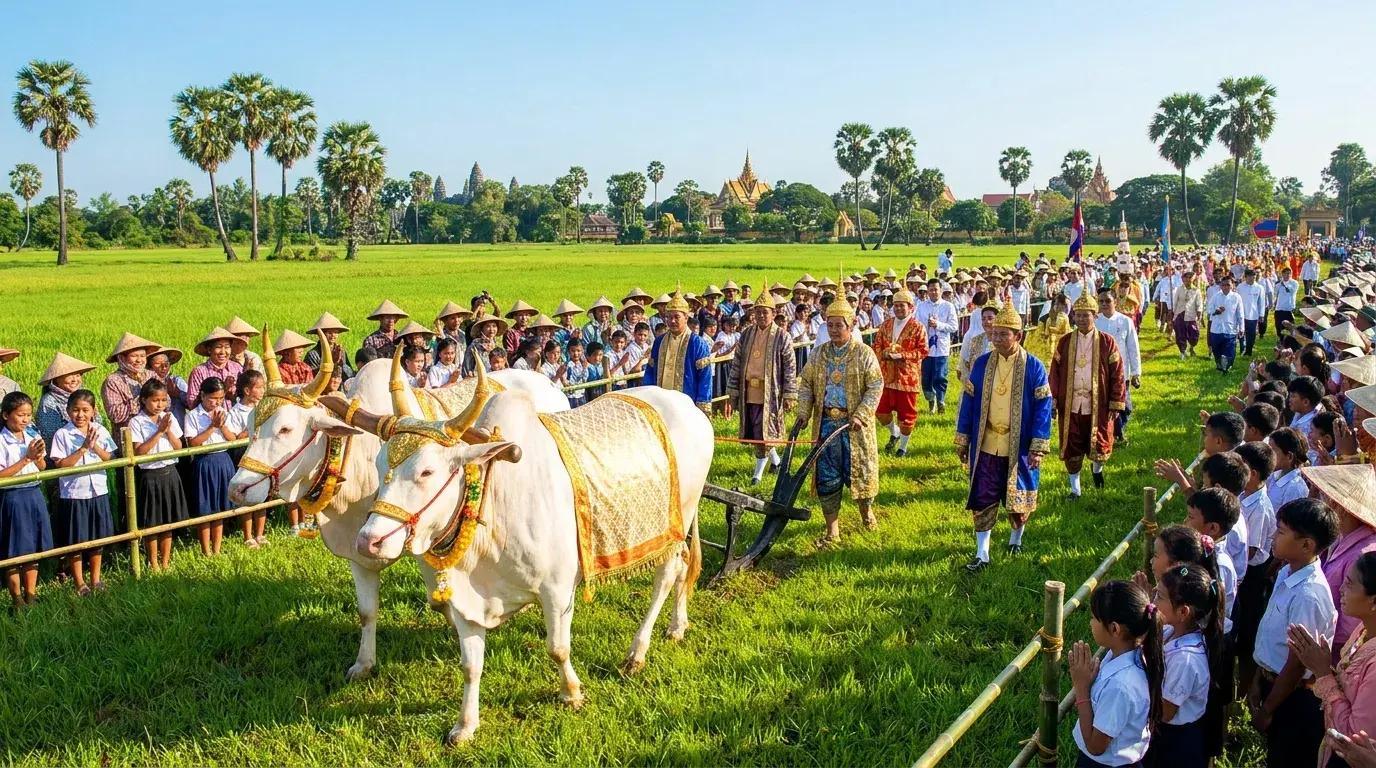
The Royal Ploughing Ceremony opens Cambodia’s rice-growing season each May at Veerapreah Men field in Phnom Penh. Led by the King or a royal representative, sacred oxen plough a furrow and choose among offerings, forecasting the harvest of the year ahead.
Royal Ploughing Ceremony
In Cambodia the Royal Ploughing Ceremony gives farmers a festive send-off into the new rice year. Each May a large crowd gathers at Veerapreah Men field beside the Royal Palace in Phnom Penh to watch the symbolic first ploughing. The King attends in person or names a senior representative to stand in his place, and the whole morning works as a public announcement that the planting season has arrived.
Cambodia
Farm families in Cambodia treat this day as encouragement straight from the palace to head into the fields. The Khmer name Preah Reach Pithi Chrot Preah Neangkol points to a holy ploughing, with old words drawn from Khmer mixed with Pali and Sanskrit. Brahmin priests lead chants, court officials assist, and everything is staged to wish for fertile soil and steady rain.
The custom reaches far back. It came to Southeast Asia with ancient Indian traditions during the Funan era in the first to sixth centuries, and stories linked to it appear in the Reamker and other Buddhist writings. At Angkor Borei, once a Funan capital, archaeologists found a sixth-century image of Balarama carrying a plough, which many view as the oldest clue that the rite mattered here long ago.
Today it ranks among the most loved state ceremonies in the Kingdom. The King usually chairs the event, or he assigns a trusted stand-in when he cannot attend. On some occasions the monarch has even held the plough handles and walked behind the oxen himself, which crowds always remember.
Date
Expect the festival in May, though the exact morning shifts every year. Royal astrologers study the lunar calendar and the hora charts, then the palace announces the chosen day, which is kept as a public holiday. In recent years Phnom Penh has often picked a Tuesday or a Saturday, so schools and offices close and families can come to watch.
If you plan to go, arrive early at Veerapreah Men because shade is limited and the programme starts in the cool morning hours. When rains stay late, villages may hold their own extra prayers for water, such as processions and pagoda ceremonies, but the royal ploughing itself remains the national starting gun for the season.
Rituals
After the furrow is cut, attention turns to the pair of royal oxen. Attendants set out trays with rice, maize, mung beans, sesame, fresh grass, water and rice liquor, then step back and let the animals choose freely. Court Brahmins and astrologers read the choices as a forecast for the months ahead: a hearty appetite for rice or maize hints at a strong harvest, while a turn toward grass or water suggests farmers should watch pasture, rain and pests. The mood is celebratory rather than scientific, yet many households still discuss the result as a guide for the season.